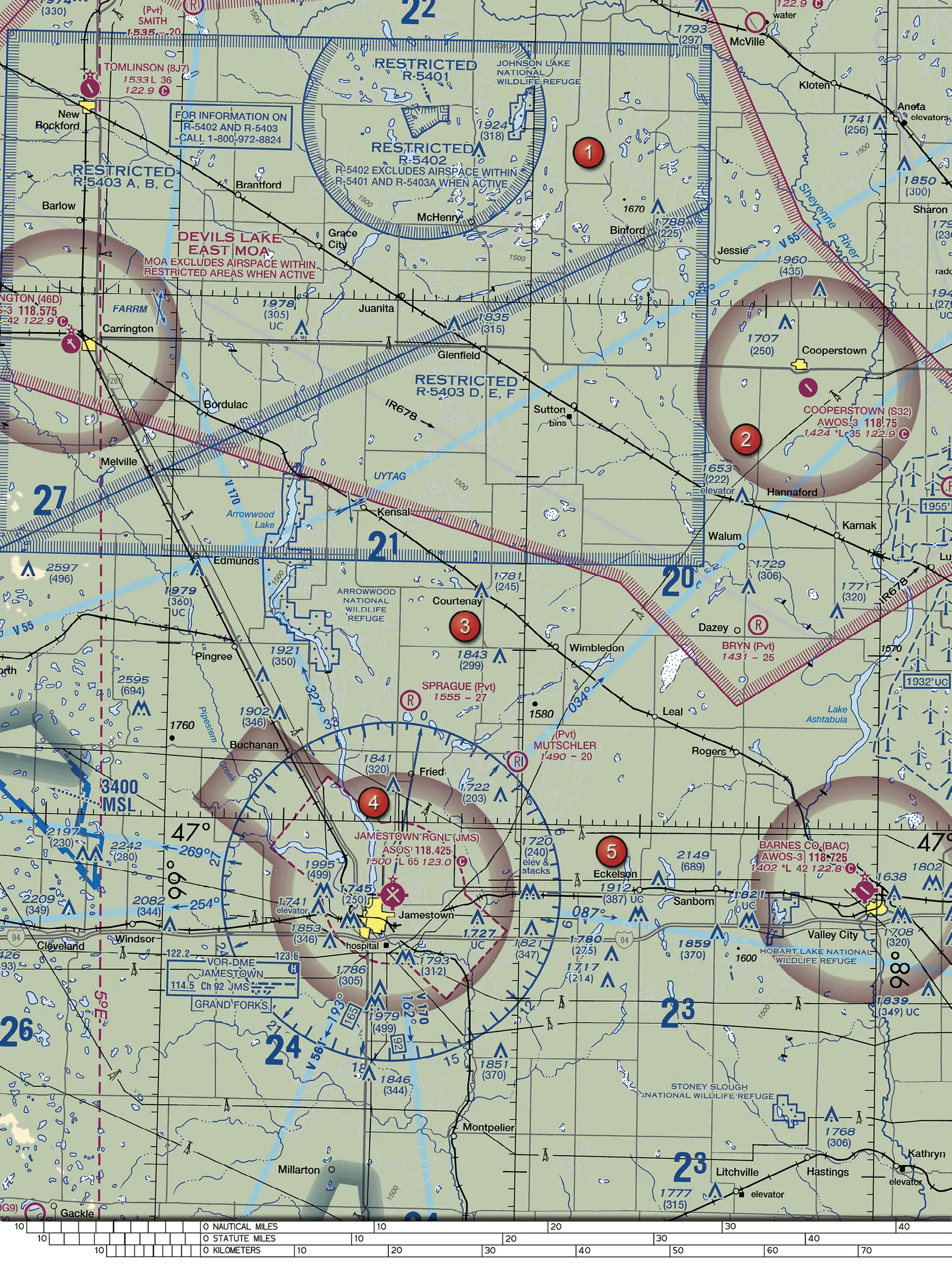
(Refer to Figure 26.) A remote pilot will film a runway inspection at 100 feet AGL on the grounds of Cooperstown Airport (S32), north-east of area 2, inside the faded magenta ring. No dashed line surrounds the airport. According to the AIM, what does this on-airport flight require?
- APrior ATC authorization through LAANC, because Class E airspace begins at the surface at this airport
- BCoordination with the airport operator; no ATC authorization is needed in this Class G airspace
- CA request submitted through DroneZone, as the AIM requires for every on-airport operation
Show answer and explanation
Correct answer: B. Coordination with the airport operator; no ATC authorization is needed in this Class G airspace
Cooperstown sits in a magenta vignette, so controlled airspace (Class E) begins 700 feet above the ground, and no dashed line marks a surface area. At 100 feet AGL the small UA is in Class G, which remote pilots may generally use without special permission, so neither LAANC nor a DroneZone request applies. Because the flight is on the airport itself, the current AIM (11-7-1b) says it requires coordination with the airport operator. AC 107-2A 5.10.1 (2021) says that outside controlled airspace no notification or authorization is necessary at or near an airport; for operations on the airport, the newer AIM 11-7-1b is the current guidance, which is why this question asks what the AIM says.
- A. Incorrect. The faded magenta ring marks Class E beginning 700 feet above the ground, and no dashed surface-area line surrounds the airport, so at 100 feet AGL the flight is in Class G, where no ATC authorization is needed.
- B. Correct. The AIM says sUAS operations on airports require coordination with the airport operator (and other parties where applicable). The airspace at 100 feet AGL is Class G, so no ATC authorization is needed.
- C. Incorrect. The AIM requires DroneZone requests for on-airport operations within controlled airspace. This flight is in uncontrolled Class G airspace.
Marked on Figure 26: Cooperstown Airport (S32) and its magenta vignette.
Aeronautical Information Manual (AIM), Basic with Changes 1, 2 and 3, 11-7-1b sUAS operations on airports require coordination with the airport operator and respective air traffic control facility, Spectrum, the FAA Regional Airport District Office, or the State Department of Aviation, where applicable.
Aeronautical Information Manual (AIM), Basic with Changes 1, 2 and 3, 11-7-1b Due to the complex nature of these operations, requests for on-airport operations within controlled airspace must be submitted via DroneZone for coordination with the air traffic control facility.
Aeronautical Information Manual (AIM), Basic with Changes 1, 2 and 3, 11-4-6a sUAS remote pilots and recreational flyers are generally permitted access to uncontrolled airspace without special permission.
FAA Chart Users' Guide (Aeronautical Chart User's Guide), complete, VFR Terms and Symbols, Airspace Controlled airspace floors of 700' above the ground are defined by a magenta vignette
AC 107-2A Small Unmanned Aircraft Systems (sUAS), 5.10.1 Unless the flight is conducted within controlled airspace, no notification or authorization is necessary to operate a small unmanned aircraft at or near an airport.